Under the Bonnet, Not Off by Heart: A Calmer Way to Learn Show Me, Tell Me
You can usually spot the learner who has learned the answers off by heart. The words come out perfectly, right up until the examiner says something like, 'and could you switch the rear fog light on for me?' Then comes the pause, the hopeful prodding of a stalk, and the slow realisation that reciting a sentence and operating a switch are two different skills.
The show me, tell me part of the UK practical test is not a quiz. It is a short, practical check that you know the car you are about to drive is in a fit state to be driven. Once that clicks, the answers stop being lines to memorise and start being things you already do.
Why the questions exist in the first place
The DVSA does not ask these questions to catch people out. It asks them because a driver who never glances at their tyres, never checks a brake light and never thinks about visibility is a driver who will eventually have a very bad day. The test is simply asking you to show that you know where things are and why they matter.
That is the first thing to hold on to. There are dozens of possible questions, but they all come back to one idea: know the condition of the thing you are driving. Tyres, lights, brakes, fluids, visibility. Everything else is detail.
The first two minutes, when the nerves are loudest
The tell me question usually comes before you have moved an inch, engine off, sitting in the test centre bay. For a nervous learner, that is the worst possible moment for a memory test. Your hands are cold, your mouth is dry, and someone official is watching you.
This is exactly why learning the answers in a book is not enough. If you have only ever read the list, that is the moment it disappears. If you have physically checked your oil, cleaned a windscreen and switched on fog lights a dozen times, the question is just another thing you have done before.
A five-minute walk-round, once a week
Forget cramming. Instead, build a small routine you repeat once a week, either before or after a lesson. It does not need to be a full service. It needs to be the same set of actions, in the same order, said out loud.
Start with the lights. Headlights on, walk round the car, check the tail lights, then the indicators using the hazard switch. Press the brake pedal while a helper watches, or use a wall or a shop window to see the reflection. Then move to the tyres: pressures when cold, tread depth of at least 1.6mm across the central three-quarters of the tyre and around the whole circumference, and a quick look for cuts and bulges. Valve caps back on.
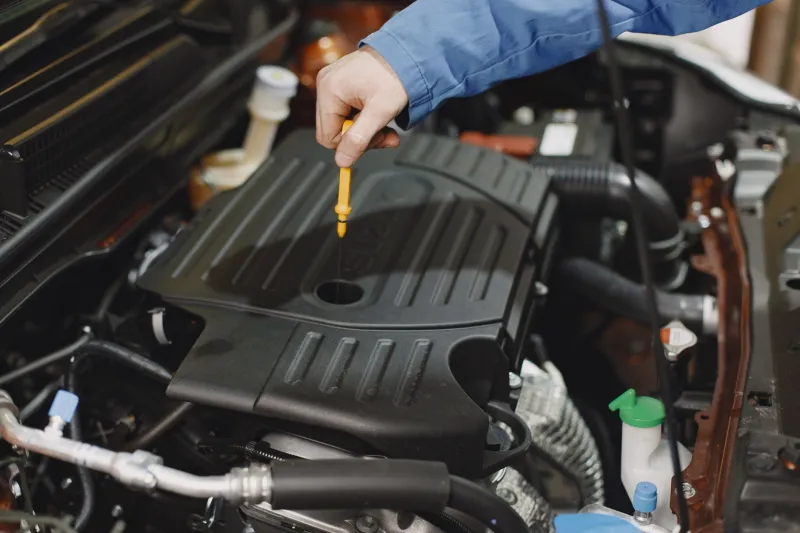
Under the bonnet, check the oil with the dipstick, the coolant level against the markings, and top up the screen wash. Then sit in the driver's seat, switch the ignition on, and watch which warning lights come on and which go out. Finally, set the demister controls properly — fan, temperature, direction, and the heated screen if the car has one — so that clearing the windscreen is something you can do without thinking.
Say the answer out loud while you do it. 'I'd check the tyre pressures when the tyres are cold, using the figures in the handbook.' That sentence sticks far better when your hand is on the valve cap.
The ones people trip over
A few questions cause more trouble than the rest, usually because the wording hides something simple.
Tyres are the big one. 'Cold' means before the car has been driven far, not after a motorway run. The recommended pressures are in the handbook or on a sticker inside the fuel flap or door pillar. Do not forget the spare, and put the valve caps back on.
Tread is another. The legal minimum is 1.6mm across the central three-quarters of the tyre, around the entire circumference. That is a minimum, not a target. A tyre at 1.7mm is legal and still not something you want in standing water.
Head restraints are often described as a comfort feature. They are not. The rigid part should be at least as high as your eyes or the top of your ears, and as close to the back of your head as is comfortable. It is there to reduce whiplash, and the examiner wants to hear that you know why.
Fog lights are straightforward once you have used them: rear fog lights when visibility drops below 100 metres, and off again when it improves. Know where the switch is and know the warning light on the dash.
Anti-lock braking is a favourite because it sounds technical. Keep it simple. If the ABS warning light stays on, there is a fault. Normal braking still works, but you will not have the emergency assistance in a hard stop. Know what the light means before you need it.
Brakes, meanwhile, should not feel spongy or slack, and the car should not pull to one side when you test them gently as you set off. That is the whole answer.
Show me, on the move
The show me question comes later, once you are driving, and the examiner will pick a safe moment. Demisting the windscreen, washing it with the washers, switching on dipped headlights, using the horn, putting the rear fog lights on. The skill being tested is not speed. It is control.
Keep your attention on the road. If the moment is not safe — a busy junction, a tight bend, a line of parked cars — say so and do it when there is a quieter stretch. That is not a failure. It is exactly the judgement the examiner is looking for.
What examiners are actually watching
A wrong answer is normally recorded as a single driving fault, not an automatic fail. But the fault is not really the point. The point is that the same checks are what keep you legal and safe after the test, when there is nobody in the passenger seat marking anything.
The examiner is watching for composure and safe control. A learner who says, 'give me a second, I'll do that on the straight,' is showing better judgement than one who jabs at a stalk while drifting towards the kerb.
Making it stick
Pair every question with a physical action. Ask whoever supervises your practice to quiz you at random, ideally while you are doing something else. Record yourself saying the answers and listen back on the bus. Use the car you will actually be tested in, because switches move around between models.
And practise in the conditions you will actually meet. November is a gift for this: dark evenings, condensation on the glass, fog on the way to an early lesson. If you can clear a misted windscreen in the cold and dark and explain what you are doing, the test question will feel like a formality.
The quiet payoff
The show me, tell me questions are not really about the test. They are about the small habits that separate a driver who knows their car from one who simply drives it. A weekly walk-round, a glance at the tyres, a dipstick, a check that the lights work. Do those often enough and the answers take care of themselves. The composure on test day is just a by-product.