Reflections on Wet Tarmac: A Learner’s Guide to Standing Water
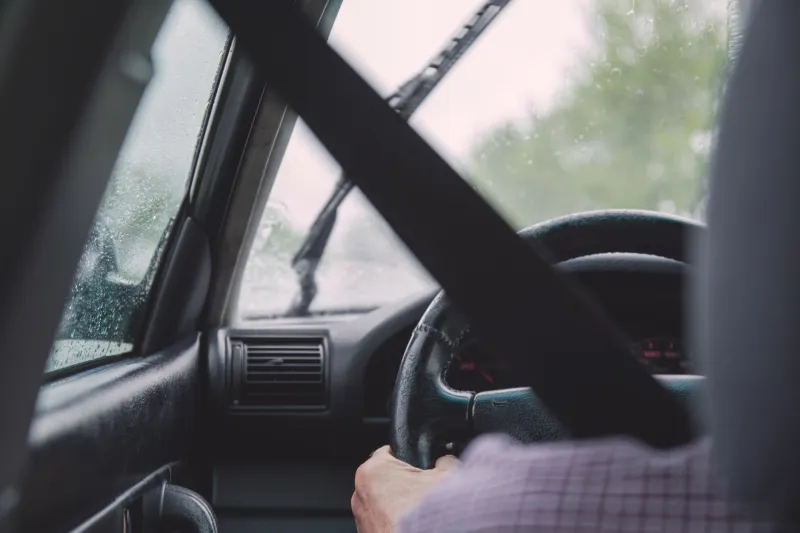
There’s a particular kind of puddle that appears after a solid night of November rain. It sits along the kerb, brown at the edges, holding a reflected slice of sky. It looks harmless enough. It also hides drain covers, potholes and the occasional surprise in the tarmac. The mature response is not to charge at it and hope. The mature response is to read it, adjust, and carry on calmly — or to choose another road entirely.
Wet-weather driving gets treated as a test of nerve. In reality, it’s a test of observation and smoothness. The best learner drivers in the rain are rarely the boldest ones. They’re the ones who notice the water early, leave more room, and keep their hands and feet quiet.
Read the water before you reach it
Standing water gives you clues if you look far enough ahead. A dark, glassy patch across the lane usually means a dip in the road or a blocked drain. Water pooling near the kerb often sits over a gully or a damaged edge. Long streaks running across the carriageway after heavy rain can mean field run-off, especially on rural routes.
On your lesson, try to scan two or three car lengths beyond the car in front rather than staring at the puddle itself. Your instructor will probably be doing the same thing. Ask yourself: is the water across the whole lane or just one side? Is it moving? Is there a clear, shallow line through it? If the answer is vague, slow down early. Braking gently while you still have grip is far better than stamping on the pedal halfway through a flood.
The short version of grip
Tyres work best when they can push water out of the way through their tread. The UK legal minimum is 1.6mm, but that’s a limit, not a target. More tread means more room for water to escape. Check your tyres before wet lessons, not after a slide. Correct pressures matter too — soft tyres can feel vague, hard tyres can skip.
Aquaplaning happens when water builds up faster than the tread can clear it. The tyre lifts, steering goes light and the car feels oddly detached. It’s not a moment for dramatic action. Ease off the accelerator, keep the steering steady and wait for the tyres to reconnect. Avoid hard braking. Avoid sharp turns. The car will usually settle once the water clears or the speed drops.
Smooth is a skill, not a personality trait
In the wet, every input is amplified. A firm brake becomes a skid. A quick steering correction becomes a wobble. So practise being early and gentle: brake sooner and lighter, steer with both hands at nine and three, and use the accelerator as if there’s an egg under the pedal.
On a quiet car park after rain — with permission, and away from kerbs and lamp posts — try a simple drill. Drive a large figure of eight at walking pace. Keep the steering movement continuous rather than jerky. Then try a gentle stop from a low speed, aiming to finish without a lurch. It feels almost too easy, which is the point. Smoothness in the wet is built at low speed, not discovered at high speed.
Give spray its own space
Spray is the wet-road equivalent of fog. Lorries and vans can throw up a curtain that leaves you driving on memory. Drop back. A four-second gap in the rain is not over-cautious; it’s sensible. It gives you time to see, time to react and time to avoid the puddle the lorry has just hidden.
Use dipped headlights when visibility is poor. Make sure your wipers are up to the job and your washer bottle is full. A clean windscreen reduces glare from wet roads and low sun. If a vehicle behind is sitting too close, don’t speed up to create a gap in front of it. Keep your own following distance and let them wait.
When the puddle wins
If you do hit water and the steering goes light, don’t fight it. Ease off the accelerator, hold the wheel steady and let the car slow naturally. Braking hard can shift weight and make things worse. Once you feel the tyres bite again, carry on gently. It’s a strange sensation the first time, but it’s manageable.
The turn-around is a proper skill
Flood water is not a challenge to be conquered. In the UK, a modest-looking ford or a swollen lane can be deeper than it looks, and moving water can shift a car off the road. If the depth is unclear, if there are no depth markers, or if the water is flowing across the carriageway, turn around. That might mean a careful reverse, a three-point turn in a safe spot or simply taking a different route. None of these are failures. They are decisions made by someone who intends to arrive.
A calmer kind of confidence
The rain will keep coming. So will the puddles, the spray and the odd white-knuckle moment. Your job is not to be the driver who barrels through. Your job is to be the driver who reads the road, leaves a margin and knows when to say no. That’s not timidity. That’s roadcraft — and it looks good on any learner.