The Screen Is Only the Rehearsal: Turning Hazard Clips Into Road Sense
Photo: Anthony O'Neil , CC BY-SA 2.0, via Wikimedia Commons
Most learners meet hazard perception clips in the same way: a mouse, a moving image and a slightly frantic urge to click before the obvious thing happens. It is easy to treat the whole exercise as a game to be beaten. Pass the theory test, close the laptop, move on.
But those clips are not just a gate to get through. They are short, safe rehearsals of the kind of looking you will do for the rest of your driving life. The test is useful. The road sense you build from it is the real prize.
Watch the clip twice, for two different jobs
The first time, watch it like a test candidate. Notice when you would click. Fine. That is the surface layer.
The second time, watch it like a driver. Pause it if you can. Ask yourself a quieter question: what changed before the hazard became obvious? A brake light flickering two cars ahead. A front wheel turning slightly. A gap between parked cars that looked empty and then did not. A pedestrian hesitating at a kerb.
That second pass is where the learning lives. On a real road, you will not get a score at the end. You will get a developing situation, and the earlier you notice the small clues, the less dramatic it becomes.
Parked cars are not furniture
A row of parked cars on a residential street can look like background. In a hazard clip, it rarely stays that way. A ball rolls out. A door opens. A child appears between two bumpers.
The clip is showing you a pattern, not a one-off. In real driving, treat gaps between parked cars as possible doors, possible feet, possible pushchairs. You do not need to brake for every gap. You do need to slow early enough that you could stop if something small and sudden appeared. That is not being overly cautious. It is reading the street properly.
When you are practising with a supervisor, try saying the pattern out loud: “Parked cars on the left, watching for doors.” It sounds simple. It keeps your eyes moving.
Junctions reward the approach, not the exit
A junction clip often shows a car waiting, a van indicating, or a cyclist arriving from an unexpected angle. New drivers tend to look at the junction itself. More experienced drivers read the approach.
Look at the waiting car’s wheels. Are they still? Look at the driver’s head. Are they looking at you, or past you? Look at the gap beyond the give-way line. Is there space to emerge, or is the road blocked by parked cars? In the UK, a junction can be perfectly clear one second and crowded the next because a bus has stopped just beyond it.
The habit to build is a sequence: mirror, lift off the accelerator, look, decide. The clip rewards early observation. So does the road.
Wet weather changes the question
In dry conditions, a hazard clip asks: can you stop? In wet weather, it asks: can you stop in time, with less grip and more spray?
Wet roads make everything feel closer. Reflections hide puddles. Spray hides brake lights. Pedestrians hurry and take chances. The clip may show someone stepping out because they are trying to reach shelter.
Use the screen to rehearse a bigger gap. On a wet day in the car, leave more room than feels necessary. Look further ahead than the car in front. Scan for umbrellas, hoods and people waiting at crossings. The hazard perception skill is not just spotting the person. It is giving yourself the time and space to respond calmly.
High streets are a moving puzzle
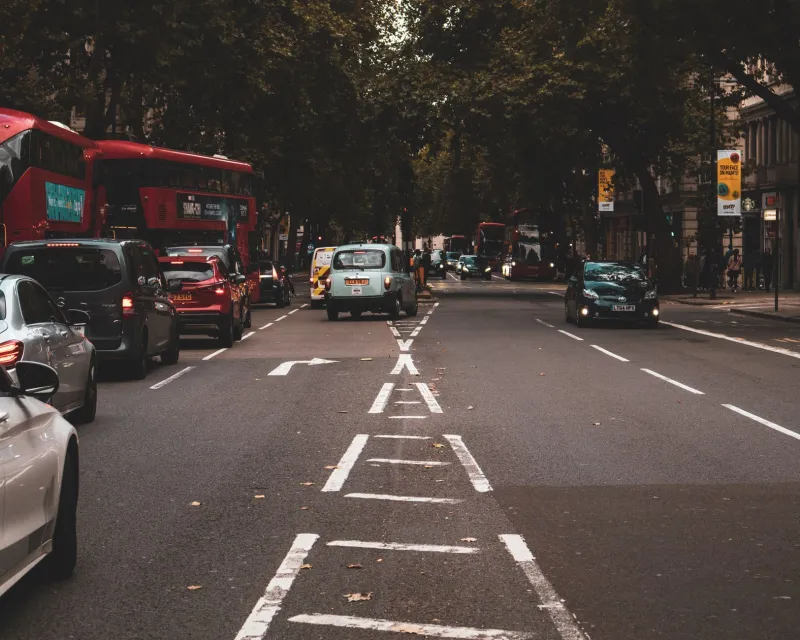
A busy high street is one of the best places to practise hazard sense because there is so much ordinary movement to read. Buses pull out. Delivery vans stop half on the pavement. Shoppers step between parked cars. Someone opens a door without looking.
In a clip, you might see a van blocking the view and a pedestrian emerging from behind it. The lesson is not “expect a pedestrian exactly there.” The lesson is “when a large vehicle blocks my view, something could be behind it.”
On the road, keep your speed low enough to think. Look through gaps rather than staring at the vehicle in front. Let your eyes travel further down the pavement and across side roads. A high street is not a place for an intense stare. It is a place for a wide, patient scan.
Turn clicking into commentary
One of the simplest ways to move from screen habits to road habits is commentary driving. With a supervisor or instructor, name what you see as you drive. Not a constant stream of chatter, just the important things: “Pedestrian waiting on the left.” “Car edging out of that side road.” “Wet road, bigger gap.”
This does two things. It slows your thinking down, and it shows your supervisor what you have noticed. If you miss something, they can point it out without a jump or a sharp instruction. You begin to build a library of patterns rather than a pile of near misses.
When you miss a hazard, review it gently
Missing a hazard in a clip is not a disaster. It is information. Go back and ask what clue you overlooked. Was it a brake light? A shadow? A change in the road surface? Did you stare at one car and forget the pavement?
Do the same after a lesson. If your instructor had to point something out, talk it through afterwards. The aim is not to be perfect. The aim is to notice a little earlier next time.
The test is a milestone, not the finish
Passing the theory test in 2026 is a useful step. It proves you can recognise hazards in a controlled setting. But the real skill is carrying that attention into ordinary drives: the school run, the wet high street, the narrow residential road with cars parked both sides.
The screen is only the rehearsal. The road is where you put it into practice.