The Lane That Keeps Office Hours: Reading Bus Lane Times as a New Driver
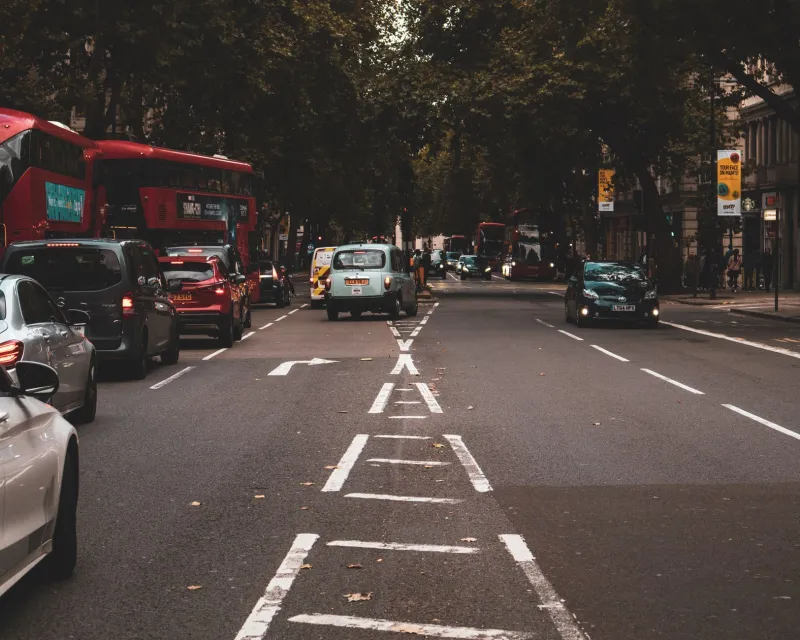
I've lost count of the number of learners who go completely quiet on me as we approach a bus lane. It's rarely the lane itself that does it. It's the small white plate underneath the blue sign, the one with the times on it, which they've spotted roughly four seconds before we reach it.
That four seconds is the whole problem. Not the lane, not the sign, not the traffic. Just the timing of when you read it.
The sign is only half the story
A bus lane sign is a blue rectangle with a white bus on it, usually with the words BUS LANE. That tells you what the lane is. It does not tell you when it's live. That information sits on a separate plate fixed below, and it's the bit everyone skims.
The plate gives you days and hours — something like Monday to Friday, 7am to 10am and 4pm to 7pm. Some say Saturday too. Some say At any time, which means exactly what it sounds like, so the lane is off limits to you around the clock. If you see a bus lane with no time plate at all, treat it as operating all the time until something tells you otherwise.
Worth knowing, too: the rules are set locally. A lane in central London on a red route may run 7am to 7pm, while the one near your aunt's house in a market town might only bite during the school run. Never assume the hours you learned at home apply twenty miles away.
Three things that look alike from a distance
Learners often bundle these together, and then panic about all three at once.
The bus lane is the wide one. You'll see the words BUS LANE painted on the surface, a solid white boundary line, and the blue sign with its time plate. During its operating hours, you stay out unless the sign says otherwise — some do permit taxis, or bicycles, or both, and the plate will tell you.
The bus stop is a stopping restriction, not a driving one. You'll spot it by the broad yellow line along the kerb and the BUS STOP lettering. You can drive straight past one quite happily. You simply can't park or wait there.
The cycle lane is narrower, marked with a bicycle symbol. A broken white line usually means it's advisory; a solid one means stay out of it. It is not a bus lane, and it is not a place to tuck in while you think about your next move.
There's also the bus gate — a short stretch, sometimes only a few car lengths, that only buses may pass through. They're easy to miss because there's no long lane to warn you, and they're often camera enforced. If a sign shows a bus and a red circle, slow down and read it properly.
Decide at fifty metres, not five
Here's the routine I teach, and it works because it removes the last-second element entirely.
As you approach, look well ahead — past the car in front, not at its bumper. Spot the blue sign early. Read the plate out loud if it helps: Monday to Friday, seven till ten. Then decide. Enter, or don't. Make the call while you're still comfortably far away, and adjust your speed once, smoothly.
If you're already alongside the sign before you've read it, don't lunge across. Carry on in the lane you're in, stay legal, and move over at the next safe opportunity — or just don't use the bus lane at all. Nothing bad happens. You lose a few seconds and that's it.
One more thing worth knowing: the boundary line usually breaks into dashes near junctions and side roads. That's where you're permitted to cross, for turning or access. Cross where the line is broken. Not where it's solid.
Traps that catch people on test routes
A few recurring ones, all of which are ordinary and none of which are personal:
- The half-hidden plate. A low branch, a parked van, a bus shelter — any of them can obscure the hours. If you can't read it, don't guess.
- The lane that starts just after a junction. You turn left and the bus lane has already begun. Everyone is bunched up and nobody has read anything. Slow down, settle, then decide.
- Different hours on different days. Saturday morning rules are not Monday morning rules, and 8:40am on a weekday is peak enforcement time.
- The left turn with a live bus lane on the approach. Examiners expect you in the correct lane at the right moment, not in the final ten metres. That's a positioning decision, and it starts with reading the sign, not the mirrors.
When you're genuinely unsure
Stay out. Driving in the ordinary traffic lane beside a bus lane is completely legal. It costs you perhaps fifteen seconds of queue. A penalty charge notice costs a good deal more, and a sudden swerve across a solid white line costs more still — in marks, in confidence, and occasionally in paint.
For a learner, I stayed out because I wasn't certain is a perfectly respectable answer. It shows judgement, which is precisely what's being assessed.
A note for the anxious
Bus lanes are, oddly, some of the kindest road you'll meet. Unlike other drivers, they don't have moods. They follow a printed timetable. Read the plate, say the hours to yourself, and the lane stops being a threat and becomes what it actually is: a bit of tarmac with a schedule.
Phil's final thought — if you take one habit from this piece, make it the early read. Eyes up, plate read, decision made, and the whole thing becomes a non-event.