When the Lane Shrinks: A Learner’s Field Guide to UK Rural Roads
Town driving teaches you to deal with traffic lights, bus lanes and the endless game of who goes first at a mini-roundabout. Rural roads teach something else: patience, observation and the fine art of reversing into a muddy gateway without losing your cool. If you learned mostly in town, the first proper country lane can feel like a different planet. The road is narrower, the hedges are taller and the sheep have no road sense whatsoever.
This is not a reason to avoid rural roads. They are some of the best places to build real roadcraft. You just need to know what the lane is asking you.
Reading the road before it reads you
Start with the basics. Look at the width of the road, the height of the hedges and the line of the bend. On a narrow lane, the centre line may disappear entirely — and that is a clue. It means you need to be ready to share the road, not defend your half of it. Watch for mud, gravel, standing water and the dark patches where a tractor has been. These are not decoration. They are grip warnings.
Use your eyes further ahead than you would in town. Look through the bend, not at the hedge in front of it. If you cannot see around the corner, assume something is coming. Ease off before the bend, not in the middle of it. A good rule for rural roads is simple: if you cannot stop in the distance you can see to be clear, you are going too fast.
Single-track roads and passing places
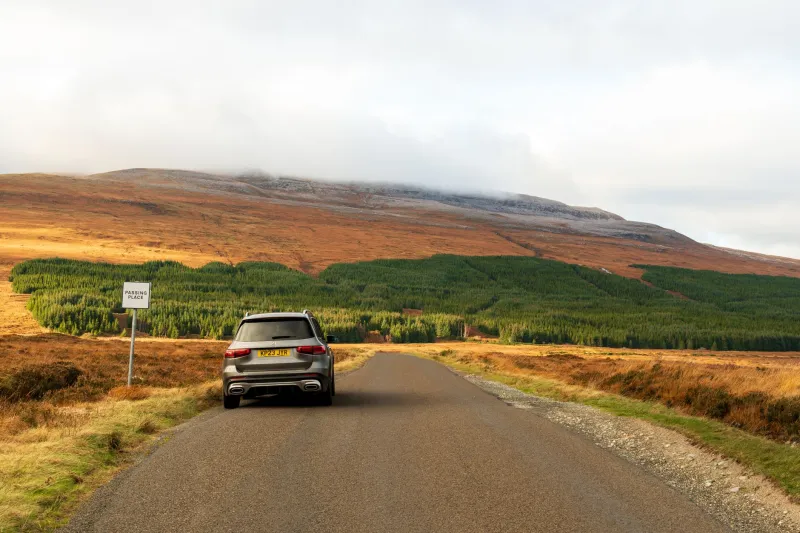
Single-track roads are the ones where two cars cannot comfortably pass side by side. Passing places are the wider pockets, usually marked with a sign or a diamond shape, and they are the key to the whole system. Use them to let oncoming traffic through, to allow faster vehicles to overtake, and to turn around if you need to.
If you meet another vehicle, the general idea is to pull into the nearest passing place on your left. If the passing place is on the other side, or if the other driver is closer to one, they may use it instead. Do not park in a passing place. Do not use one as a picnic spot. They exist to keep traffic moving.
When you pull in, slow down gently and keep your wheels straight until you are fully inside. A passing place is not a race. If you are the one who needs to reverse, do it slowly and deliberately. Use your mirrors, keep the car straight and reverse only as far as you need. If you have a passenger, ask them to guide you — but agree the signals first. ‘Keep coming’ and ‘stop’ are more useful than frantic waving.
When the other driver gets there first
This is the moment that makes learners panic: another car appears, the lane is too narrow, and someone has to reverse. If the other driver is already in the passing place, or is closer to one, let them have it. Stop in a safe, visible spot and wait. Do not edge forward into a gap that is not there. If they wave you through, acknowledge it with a polite wave of your own and move steadily. If they start reversing, stay put and give them room.
Polite waves matter on rural roads. They are the local currency. A small raise of the hand costs nothing and makes the next narrow encounter feel less like a standoff. If someone lets you through, thank them. If you make a mistake, a brief wave of apology goes a long way. Rural driving is a shared activity, even when you are the only car in sight.
Tractors, sheep and other surprises
Farm vehicles are wide, slow and often covered in mud. Treat them with respect. Hang back until you can see far enough ahead to overtake safely, and do not try to squeeze past on a blind bend. If a tractor pulls into a field to let you by, take the gift and go. If it does not, be patient.
Animals are a different kind of hazard. Sheep move as a group, usually in the wrong direction. Slow down early, keep your distance and do not use the horn. A farmer moving livestock may wave you through or ask you to wait. Follow their lead. Horses need the same courtesy: pass wide and slow, and avoid revving the engine.
Reversing without the drama
Reversing on a narrow lane is a skill in its own right. Before you move, check behind you properly. Use all your mirrors, look over your shoulder and make sure you know where the edges are. Reverse slowly, keep the car straight and stop if you are unsure. It is far better to stop and reassess than to reverse into a hedge because you were too proud to pause. If you have a supervisor with you, ask them to guide you from outside the car only if it is safe to do so. Otherwise, agree simple hand signals before you start.
The rural road mindset
Rural roads reward the calm driver. They ask you to read the surface, plan ahead and share space with people who may not be in a hurry. They also ask you to accept that you cannot control everything — the tractor, the sheep, the driver coming the other way. What you can control is your speed, your observation and your manners.
So next time the lane shrinks, do not grip the wheel harder. Ease off, look ahead, choose your passing place and wave when it is over. That is not just good driving. It is good roadcraft.