The Amber Pause: Building Calm Judgement at UK Traffic Lights
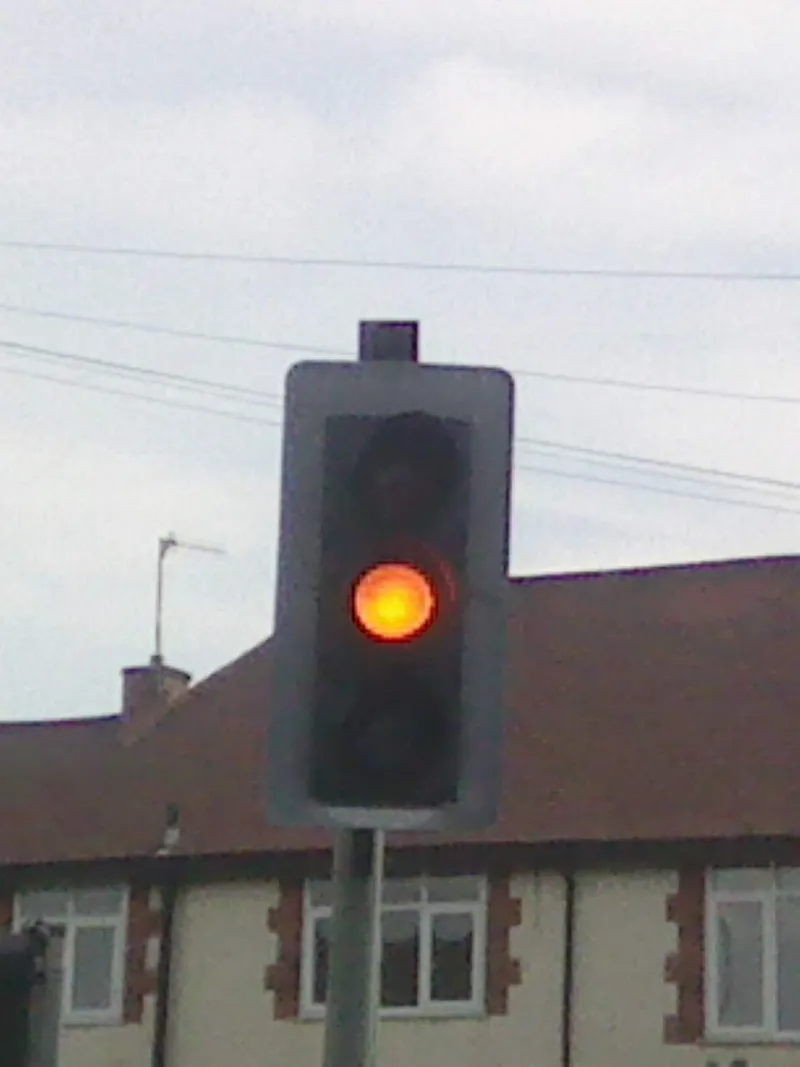
Photo: Gary , CC BY-SA 2.0, via Wikimedia Commons
Amber lights have a reputation problem. Learners often treat them like a dare: speed up, squeeze through, hope for the best. Others treat them like a full emergency: stamp on the brake, apologise to the car behind, and spend the next mile reliving it. Neither response is really driving. Both are reactions.
The calmer way to think about amber is simpler. It is a question, not a command. The question is: can I stop safely before the line? If the answer is yes, you stop. If the answer is no, you continue steadily and sensibly. The skill is not in having faster reflexes. It is in arriving at the junction early enough to hear the question clearly.
What amber is actually asking
The Highway Code is clear enough: amber means stop, unless you have already crossed the line or you are so close that stopping could cause an accident. That second part is where judgement lives. It is not a licence to put your foot down. It is permission to keep going when braking would be more dangerous than continuing.
For a learner, the useful shift is to stop seeing amber as a last-minute signal. By the time the light turns amber, most of your decision should already be half-made. You should know your speed, the road surface, the car behind and the space ahead. Amber simply confirms what your approach has been telling you.
The approach starts long before the light
A traffic light is not a quiz that begins when the bulb changes. It begins two hundred metres back, when you first spot the junction. On an ordinary 30mph road, that gives you plenty of time to do the quiet work: ease off the accelerator, check your mirrors, and decide whether you are in the right lane.
If you are approaching a green light, ask yourself a simple question: if this changes now, can I stop comfortably? That question keeps your speed honest. It also stops you from being surprised. A green light is not a guarantee. It is a prediction with a short shelf life.
Try to avoid the habit of accelerating towards green. It feels efficient, but it narrows your options. A steady approach gives you room to stop, room to continue, and room to react to the car in front doing something unexpected.
Mirrors before brakes
When amber appears, the first action is not braking. It is checking. Your centre mirror tells you what the car behind is doing. Your left mirror matters if you are thinking about pulling up or changing lane. Your speed and distance from the line tell you whether a stop is realistic.
This is where many learners get caught out. They see amber, brake immediately, and only then notice the van sitting close behind. The stop was well-intentioned, but it was not planned. A mirror check first does not waste time. It buys you information.
If someone is following too closely and you are already near the line, continuing steadily may be the safer choice. If you have plenty of room and the car behind is at a sensible distance, stop smoothly. The decision is not about being polite to the light. It is about managing the whole scene.
Stopping distance without the maths lesson
You do not need to recite stopping distances at every junction, but you do need a feel for them. A typical stopping distance at 30mph is around 23 metres in dry conditions. In the wet, it roughly doubles. That is a long stretch of road, and it is why late braking is rarely the clever option.
On a dry day, a gentle stop from 30mph should feel undramatic. You ease off, brake progressively, and come to rest without the car dipping forward. On a wet day, you need even more space and an earlier decision. If the road is greasy after rain, treat amber with extra respect. The light may be the same, but the tarmac is not.
This is also why the right foot should not be hovering between pedals in a state of panic. It should be doing one of two things: easing off, or braking smoothly. Indecision is what makes a stop feel rushed.
Following traffic and the car behind
A traffic light decision is never just about you. The car in front may stop sharply. The car behind may be distracted. A cyclist may be filtering past. A pedestrian may be waiting to cross. Amber asks you to fit your choice into that moving picture.
Leave a sensible gap as you approach. If the car in front blocks your view of the lights, use the repeater signal on your side of the road where available. Do not tailgate to see better. That only removes your options.
If you decide to stop, stop decisively but gently. If you decide to continue, continue at a steady speed and do not accelerate to beat the red. The aim is to be predictable. Other road users cannot read your mind, but they can read a car that is slowing smoothly or holding a steady speed.
Decisive is not the same as rushed
A decisive choice feels quiet. A rushed choice feels tight. Decisive means you saw the amber, checked, and committed early. Rushed means you saw the amber late, stabbed the brake, and hoped. Learners often think decisiveness means acting fast. In reality, it usually means preparing early.
A good test is this: could you explain your choice calmly after the event? If you stopped, you should be able to say why it was safe. If you continued, you should be able to say why stopping would have been riskier. If the honest answer is that you panicked, that is useful information, not a failure. It tells you where to practise next time.
Three drills for ordinary junctions
First, try the commentary approach. As you near a set of lights, say out loud what you see: green light, speed, mirror, car behind, gap ahead. Keep it short. The point is to build a routine, not to give a lecture to the windscreen.
Second, use the what-if game. On approach, ask: if this turns amber now, can I stop? Answer before it happens. Do this ten times on a lesson route and you will start to feel the decision forming earlier.
Third, practise smooth stops. Find a quiet stretch with a clear marker, such as a lamppost, and brake as if you were stopping at a light. Aim for progressive pressure, no last-second jolt. Then do the same in the wet if conditions allow. The feel of a calm stop is worth more than a page of theory.
When you get it wrong
You will sometimes misjudge an amber. You may stop when you could have continued, or continue when you could have stopped. That is part of learning. What matters is not pretending it did not happen. Talk it through with your instructor. Was the approach too fast? Were the mirrors late? Was the car behind too close? The answer will usually point to the approach, not the light itself.
Amber is not there to catch you out. It is there to give you a moment to choose. Treat it as a question, give your right foot time to answer, and the whole junction starts to feel less like a trap and more like ordinary roadcraft.