Quiet Tarmac, Real Progress: Turning an Empty Car Park into Your Practice Ground
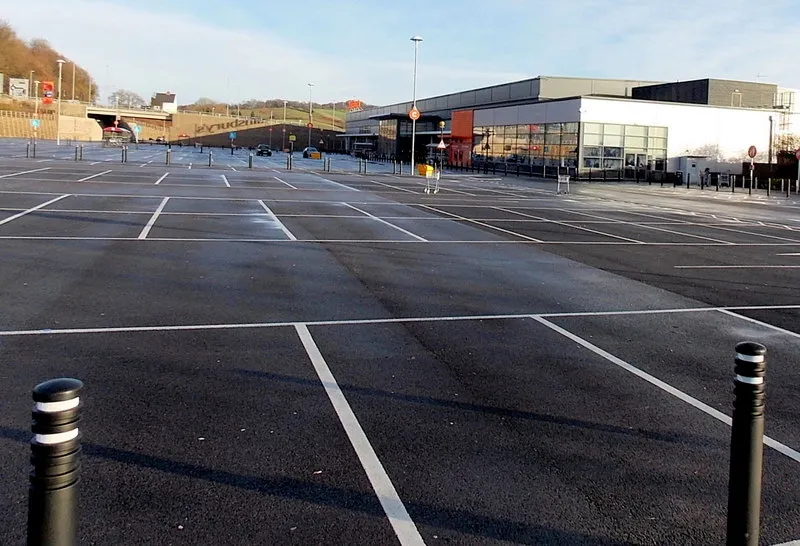
Photo: Jaggery , CC BY-SA 2.0, via Wikimedia Commons
Most learners file supermarket car parks under ‘parking’ and nothing else. That is a shame. A quiet car park, after the shutters are down and the trolleys have gone home, is one of the most useful rehearsal spaces a nervous learner can ask for. It is flat, predictable and wide open. You can stop, reset and try again without a queue of traffic behind you. It is not a substitute for proper lessons or real-road experience, but it is a brilliant place to build the small skills that make those lessons less overwhelming.
Why the quiet tarmac works
Driving lessons are full of decisions. Car parks strip most of those decisions away and leave you with the basics: clutch, steering, observation and patience. That is exactly what a nervous learner needs. When the environment is calm, you can notice what your hands and feet are doing. You can make a mistake, laugh at it, and go again.
The key is repetition. Not ten different manoeuvres in twenty minutes, but one manoeuvre ten times, slowly. That is how a car park stops being a place you avoid and becomes a place where things start to click.
Before you turn the key
A little preparation keeps the session on the right side of sensible.
- Go outside opening hours. Early Sunday morning or late evening is usually best. Avoid delivery times, school pick-up rushes and any moment when the store is busy.
- Check the signs. Most supermarket car parks are private land, and some have time limits, restrictions or overnight security. If you are asked to move on, do so politely.
- Make sure you are insured. A learner driver needs the right cover, and the supervising driver needs to be qualified and insured too.
- Display L-plates if you are driving on a provisional licence. Keep them visible even in a quiet car park.
- Walk the space first. Look for trolley bays, kerbs, bollards, cycle racks and any dark corners. Pick a simple area with plenty of room.
- Keep it short. Twenty minutes of focused practice is worth more than an hour of tired circling.
Drill 1: The slow roll and stop
Find a long, empty stretch with a painted line to use as your marker. The aim is simple: move off smoothly, creep forward a few car lengths, then stop under control.
In a manual, find the biting point, release the handbrake, and let the car move without adding much gas. Stop, reset, repeat. In an automatic, practise moving off and braking so gently that a passenger would not spill a drink. Do this ten times. The goal is not speed. The goal is smoothness.
Before every move, say quietly: ‘Mirrors, blind spot, clear.’ It feels silly in an empty car park. That is fine. You are building a habit that will feel natural when the car park is not empty.
Drill 2: Forward bay parking with reference points
Choose a bay with empty spaces on both sides, and an empty area opposite. Approach wide and slowly. Use your left mirror to check the bay line, and keep your speed to a crawl.
Pick two reference points. The first might be when the bay line appears in a certain part of your side window. The second might be when the line sits in a particular place in your wing mirror. Every car is different, so treat these as starting points and adjust with your supervisor. Stop when the car is straight and fully inside the bay.
Get out and look. Then do it again. The repetition is the lesson.
Drill 3: Reverse bay parking
Use the same quiet row. Pull past the bay by about two bays, keeping a sensible gap from the parked cars. Stop. Check your mirrors and blind spot. Reverse slowly, using the bay line in your side mirror as your guide. If the car starts to swing too wide, stop, pull forward and reset. There is no shame in resetting. In fact, resetting is a skill.
Do the same bay three or four times. Your reference points will start to feel familiar. Then try the bay next to it, so you are not just memorising one patch of tarmac.
Drill 4: Reversing straight
Find a long empty row with a painted line. Line the car up beside it, then reverse slowly along the line for ten metres. Use small steering corrections, not big turns. Check over your shoulder and in your mirrors as you go.
This drill teaches you that reversing is not a mysterious talent. It is a slow, observed movement. The learner who can reverse straight is usually the learner who stops panicking about reversing into a bay.
Drill 5: The observation pause
Before every drill, pause for three seconds. Check the left mirror, the right mirror, over your left shoulder and over your right shoulder. Say what you see: ‘Clear left, clear right, clear behind.’
In an empty car park, this can feel pointless. On a test route, it is gold. Instructors are not looking for a theatrical performance. They are looking for evidence that you check before you move. Car parks are a safe place to make that habit automatic.
Keep it calm, keep it legal
Do not practise in disabled bays, parent and child bays, loading areas, fire exits or on access roads. Do not block trolley bays or click-and-collect spaces. Even when the store is closed, these areas can be needed by delivery drivers, security staff or emergency vehicles.
Keep your speed low, watch for pedestrians, and leave if the car park starts to fill up. A quiet car park is useful. A busy one is just a car park with extra hazards.
Make it transferable
After each drill, say one thing that went well and one thing you will repeat. Then stop. You do not need to chase perfection in one evening. The car park is a rehearsal room, not the stage. Use it to build the calm, repeated movements that will serve you when you pull out into real traffic — and tell your instructor what you have been practising. They can help you carry it into the next lesson.