The Criss-Cross Check: A Learner’s Guide to Box Junctions Without the Panic
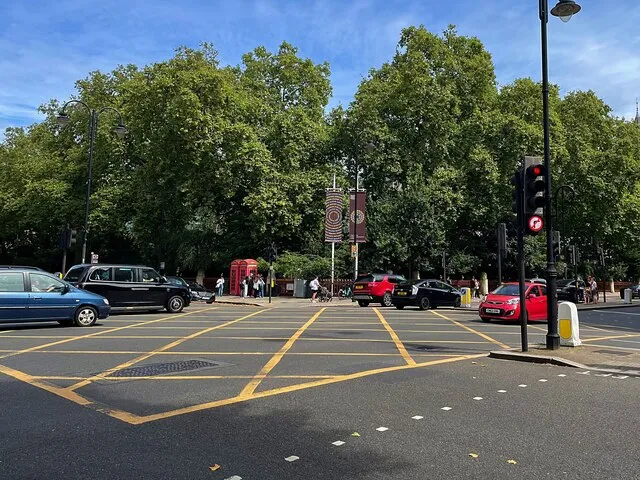
Photo: Graham Hogg , CC BY-SA 2.0, via Wikimedia Commons
There’s a particular kind of silence that happens in a learner car when the yellow criss-cross markings appear ahead. It’s not quite fear. It’s more like the brain saying, “Everyone else knows what to do here, and I’ve forgotten.”
Box junctions have a reputation. They’re painted on busy high streets, outside stations, near retail parks and at junctions where traffic already feels tight. But they aren’t there to catch you out. They’re there to stop one problem: vehicles blocking the junction when the lights change. Once you understand what the box is asking, it stops being a trap and becomes a fairly ordinary judgement call.
The question behind the yellow paint
A box junction is essentially asking one question: is my way out clear?
Not “is there a gap?” Not “can I squeeze in?” Not “will the car in front definitely keep moving?” The rule is that you should not enter the box unless your exit road is clear. In plain terms, you need to be able to drive across the box and out the other side without stopping inside it.
That’s the bit to hold onto. The box is not asking you to be bold. It’s asking you to look past the markings to the space beyond them. If the traffic on the far side is queuing back towards the box, you wait at the entrance. If the road ahead has room for your car, you can proceed.
There is one exception worth knowing. If you’re turning right and you’re only stopped in the box because of oncoming traffic, or because other vehicles are waiting to turn right, that’s allowed. You still need to be careful, but the rule is not quite as absolute as “never stop on yellow paint.”
Look at the exit, not the box
New drivers often stare at the yellow lines as if the answer is written in them. It isn’t. The useful information is further ahead.
As you approach, lift your eyes to the road beyond the box. Ask yourself:
- Is there a clear car’s length of space on the other side?
- Is the traffic ahead moving, or is it crawling to a stop?
- Is the vehicle in front likely to clear the box, or is it about to leave you stranded?
- Are pedestrians, cyclists or buses likely to interrupt the flow?
This is the same skill you use at any busy junction: reading the traffic, not just reacting to the car immediately in front. If the car ahead is halfway into the box and the traffic beyond it is stationary, that’s your cue to wait. You don’t need to follow it just because it went.
The “follow the leader” habit
One of the most common ways learners end up stopped in a box junction is by following the car in front too closely. It feels natural. The vehicle ahead moves, so you move. Then it stops, and you’re sitting on yellow criss-crosses wondering how it happened.
The fix is a little more patience at the entrance. Leave a gap. Watch what the car ahead actually does, not what you assume it will do. If it enters the box and then brakes because the exit is blocked, you want to be back at the line, not tucked in behind it.
This can feel awkward when there’s traffic behind you. Someone might be close to your bumper. Someone might be impatient. That’s uncomfortable, but it isn’t a reason to enter a box you can’t clear. A few seconds of waiting is far better than sitting in the middle of a junction while the lights change around you.
When you realise you’ve misjudged it
It happens. You thought the traffic would keep rolling. You thought the gap was bigger. You thought the bus would move. Then you’re in the box and the space ahead closes up.
First, don’t panic. Don’t slam on the brakes in the middle of the box if you’re still able to move forward safely. Don’t reverse unless it’s genuinely safe and necessary, because reversing into traffic is its own problem. Don’t wave apologetically at everyone and lose focus on the road.
The calm response is simple: keep your attention on the space ahead, move forward when it opens, and clear the box as soon as you safely can. If you’ve already stopped, stay stopped until it’s safe to continue. A mistake in a box junction is not improved by a second mistake made in a fluster.
A little mental rehearsal helps
Before your next lesson, try this. Picture a box junction. Imagine the exit is blocked. Say to yourself, “I wait at the entrance.” Then imagine the exit is clear. Say, “I can go.” That’s the whole decision.
You can also practise the observation without the pressure. As a passenger, or on a walk, watch how drivers approach box junctions. Notice who waits and who follows too closely. Notice how often the answer is obvious once you look beyond the yellow paint.
The box is not the enemy
Box junctions ask for the same thing good driving asks for everywhere: look ahead, leave room, and don’t commit to a space you can’t clear. They can feel sharp and intimidating when you’re new, especially on a busy Saturday afternoon with a queue behind you. But they’re not personal. They’re not a trap. They’re a question.
And the answer is usually found by looking past the yellow lines, checking the exit, and giving yourself permission to wait.