Blue Lights, Steady Hands: What to Do When an Emergency Vehicle Appears
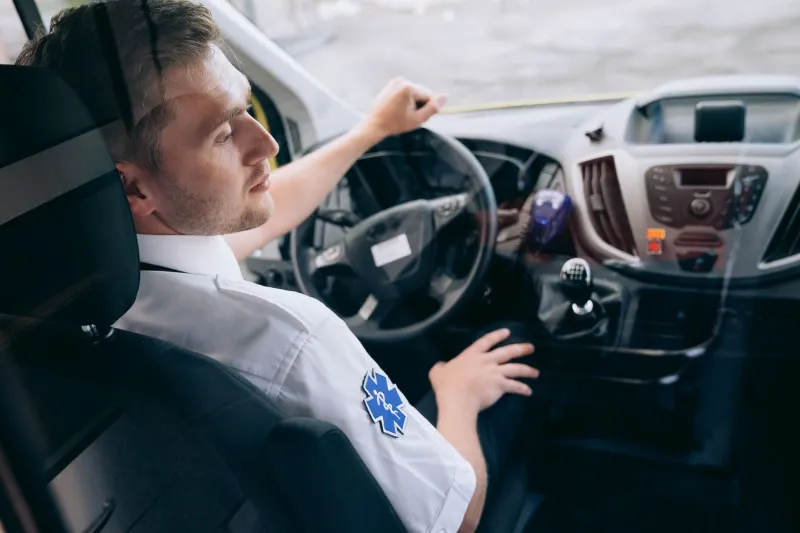
It usually starts with a flicker in the mirror. Then another. A blue light, maybe a siren, and suddenly your hands are tighter on the wheel than they were two seconds ago. The instinct can be to freeze, to brake hard, or to swing towards the kerb without really looking. None of those are unusual reactions for a learner. But none of them are the best answer either.
Emergency vehicles are part of ordinary UK driving. Ambulances, fire engines, police cars and other response vehicles can appear when you least expect them. The good news is that the skill you need is not dramatic. It is calm observation, a bit of forward planning, and a willingness to make room only when it is genuinely safe.
The Lights Are Not a Judgement
First, take a breath. A blue light behind you does not mean you have done something wrong. It does not mean you need to perform an emergency stop. It means a vehicle on official business would like to make progress, and you are part of the picture around it.
Your instructor will have seen this before. They are not expecting you to become a traffic officer in the space of ten seconds. What they want to see is that you can keep control of the car, keep checking your surroundings, and respond in a way that does not create a new hazard.
If you are mid-lesson and the lights appear, say what you are thinking. A simple ‘I can see an ambulance behind us’ gives your instructor a chance to support you. You are not being tested on telepathy.
Read the Road Before You React
Panic tends to make drivers look only in the mirror. The safer approach is to look ahead as well. Where is the nearest safe place to pull in? Is there a bus stop, a lay-by, a wide verge or a side road clear enough to use? Are you approaching a junction, a bend, a hill crest or a pedestrian crossing where stopping would be a bad idea?
The Highway Code is clear that you should consider the route of an emergency vehicle and take appropriate action to let it pass. But it also expects you to do so without breaking the law or putting anyone at risk. That balance is the whole skill. You are not trying to clear the road instantly. You are trying to find a sensible gap.
Use your mirrors properly. Check your blind spot if you are thinking of moving left. Signal if it helps other road users understand your intention. And keep your speed smooth. A sudden halt can catch the driver behind you, and the emergency vehicle itself, by surprise.
What Good Room Looks Like
Making room does not always mean stopping. Sometimes the best thing is to keep moving steadily until a safe spot appears. On a narrow residential street, that might mean easing past parked cars before pulling in. On a dual carriageway, it might mean staying in your lane until there is a clear stretch of hard shoulder or a lay-by, rather than braking in a live lane.
A few practical points are worth remembering:
- Do not mount the kerb. It can damage your tyres, unsettle pedestrians and put you at an awkward angle when you rejoin the road.
- Do not stop on zig-zag lines near a pedestrian crossing if you can avoid it. Those markings are there to keep sight lines clear.
- Do not enter a bus lane, cycle lane or restricted area just to get out of the way. The emergency driver cannot wave you through a legal restriction.
- Do not stop opposite parked cars if that would block the road completely. The emergency vehicle may still need to pass.
- Do not wave the emergency vehicle past. You cannot see what they can see, and a wave can create confusion.
The Red Light Question
This is the one that worries learners most. You are first at a red light, blue lights fill your mirror, and you feel pressure to move. The answer is simple: do not cross the stop line. Red lights apply to you. Emergency vehicles have limited exemptions in law, but learner drivers do not share them.
If there is room to move forward slightly without crossing the line, and it is safe to do so, that may help. If there is not, stay put. The emergency driver will make their own decision. They may wait, use another route, or proceed only if the law and conditions allow it. Your job is not to solve their journey at the expense of your own safety.
The same applies at a box junction. Do not enter it unless your exit is clear. Making room is not an excuse to block a junction or sit in a dangerous position.
Junctions, Roundabouts and Busy Roads
Approaching a junction, think carefully. Pulling over just before a side road can block someone turning out. Stopping right on a corner can hide you from other drivers. If you are on a roundabout when the blue lights appear, keep calm and continue to your exit. Do not stop on the roundabout itself unless traffic forces you to. Signal clearly and leave at the first safe opportunity.
On a busy high street, the safest space might be further ahead than you think. Keep your speed low, scan for gaps, and avoid sharp movements. Pedestrians may also be reacting to the siren, so give them room and time.
If You Are the Nervous One
Some learners find the siren itself unsettling. It is designed to be noticed, after all. If noise makes you tense, try to keep your breathing steady and your eyes moving. Mirror, road ahead, mirror again. You are gathering information, not panicking.
It can help to talk through the scenario before it happens. Ask your instructor what they would expect on your local roads. Where are the sensible pull-in spots near your test centre? What would you do on the dual carriageway you practise on? Rehearsing the decision-making takes some of the surprise out of the real thing.
At Phil's Driving Lessons, the aim is not to turn learners into emergency responders. It is to help ordinary drivers make ordinary, safe decisions under a bit of pressure. Blue lights are a moment to be steady, not a moment to be perfect.
When they appear, remember the simple version: check ahead, check your mirrors, make space only where it is safe and legal, and do not let the urgency in someone else's journey override your own judgement. That is a skill worth having long after your test.